Few home decor trends have looped back around as many times as macrame. The knotted plant hangers so many people associate with a single decade actually belong to a craft with roots stretching back roughly eight hundred years, carried forward by sailors, queens, and hippies alike before finally settling into its most familiar form, cradling a spider plant in a sunny window.
The craft traces back to thirteenth century Arab weavers working across North Africa and the Middle East, who knotted the loose ends of hand loomed textiles into decorative fringes rather than letting them fray. Historians generally agree the word itself grew out of Arabic, most likely from a term meaning an ornamental fringe or embroidered veil, though some trace it instead through a similar Turkish word for towel or napkin. Either way, the earliest macrame was never meant as a display piece on its own. It was a practical way to finish an edge, applied to towels, shawls, and veils long before anyone thought to hang a fern from it.
From North Africa, the technique moved into Europe following the Moorish conquest of Spain, spreading afterward into Italy and gradually across the rest of the continent. By the late seventeenth century, macrame had reached English high society, where Queen Mary II is said to have taught the knotting technique to her own ladies in waiting, giving the craft a genuine foothold among the fashionable elite of the period.
At sea, an entirely separate branch of the tradition was taking hold. Nineteenth century British and American sailors filled their idle hours aboard ship making hammocks, fringe, and belts using the technique, which they generally called square knotting after their most frequently used knot, and affectionately nicknamed it McNamara’s lace. 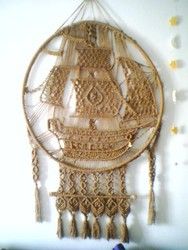 When a ship finally reached port, sailors would sell or trade these handmade pieces, spreading the craft to new harbors with every voyage.
The Victorian era brought macrame roaring back into fashion, this time as a genteel parlor pastime rather than a shipboard hobby. Instructional books such as Sylvia’s Book of Macrame Lace, published in 1882, taught Victorian women how to knot elaborate trimmings for both clothing and the home, and macrame lace soon adorned tablecloths, curtains, bedspreads, and lampshades in households across Britain and America. For a time, it was considered an essential domestic skill, much like needlepoint or crochet.
As with most needlework crafts, interest in macrame eventually faded as fashions moved on, and it might have remained a Victorian curiosity if not for an entirely different cultural moment several decades later. The counterculture movements of the 1960s brought renewed attention to handmade textile crafts of all kinds, and by the early 1970s macrame had exploded into one of the decade’s defining home decor trends. Thick, natural fiber cords replaced the delicate lace thread of the Victorian parlor, and a new generation of makers turned to macrame for wall hangings, plant hangers, clothing, and curtains, embracing the craft’s tactile, handmade quality as a deliberate counterpoint to mass manufactured goods.
The plant hanger in particular became something close to a symbol of the era. Houseplants were enjoying their own surge in popularity at the time, and a hanging basket suspended in a woven cradle of knots offered an easy way to bring greenery into a small apartment or a crowded room without giving up valuable floor or shelf space.  Jute and cotton cord, both inexpensive and widely available, made the craft accessible to almost anyone willing to learn a handful of basic knots, and macrame plant hangers soon turned up in sunrooms, kitchen windows, and porches across the country, often alongside macrame owls, wall tapestries, and fringed vests that defined the look of the decade.
By the early 1980s, tastes shifted again, and macrame drifted out of fashion nearly as quickly as it had arrived, coming to be seen by many as a dated relic of the previous decade rather than a serious craft. It never disappeared completely, kept alive by dedicated hobbyists and a small, steady stream of instructional books, but for the better part of two decades it remained mostly out of the design spotlight.
That changed again in the 2010s, when a broader revival of bohemian style brought macrame back into fashion once more, this time carried largely by social media rather than magazines or television. Platforms built around images made it easy for a new generation to discover macrame plant hangers, wall art, and jewelry, and marketplaces devoted to handmade goods gave hobbyists an easy way to sell what they made. This modern revival has tended to favor a more muted, neutral palette and simpler, cleaner knotting patterns than the bold, colorful macrame of the 1970s, but the appeal driving it feels remarkably similar: a handmade textile that turns a simple houseplant into something worth looking at twice.
What has always carried macrame through its various revivals is really quite simple. It requires no special tools, just cord, patience, and a handful of knots that can be learned in an afternoon, yet it produces something with genuine texture and presence that a store bought planter rarely matches. Whether tied by a sailor with hours to spare at sea, a Victorian woman working from an instruction manual, or a 1970s hobbyist hanging a spider plant in a sunny window, the basic motion behind every macrame knot has stayed exactly the same for centuries.
For anyone drawn to that same handmade charm today, there are meaningful ways to bring a piece of the tradition home. An original vintage 1970s macrame plant hanger carries the genuine texture and character collectors look for. For those wanting to start fresh, a macrame plant hanger kit makes it easy to learn the basic knots and create a piece from scratch, and a set of natural jute or cotton cord rounds things out for anyone hoping to try their hand at the same craft that has been quietly looping back into fashion for nearly a century.