There is a particular shade of light, honey colored wood that instantly signals mid-century modern to anyone who spends time browsing vintage furniture. More often than not, that warm blonde finish belongs to a Heywood-Wakefield piece, a name that carries far more history behind it than its sleek, streamlined furniture might suggest. What most collectors recognize as a 1950s design icon is actually the product of a company whose roots reach back well over a century earlier, into a small Massachusetts barn where five brothers first began building chairs.
The story starts in 1826, when the five Heywood brothers, Walter, Levi, Seth, Benjamin, and William, began making chairs in their father’s barn in Gardner, Massachusetts. What began as a small family operation grew steadily over the following decades, and the Heywood name became closely associated with well made wooden seating. Around the same time, a separate business was taking shape under Cyrus Wakefield, a Massachusetts entrepreneur who saw commercial potential in an unlikely material. Wakefield developed methods for turning rattan, a fibrous grass imported from Southeast Asia that had originally been used simply to pad cargo aboard sailing ships, into a workable material that could be woven into wicker furniture. His company, formally established in 1855, became a leading name in wicker and rattan furnishings throughout the second half of the nineteenth century.
For decades, Heywood and Wakefield operated as rivals rather than partners, each building a reputation in overlapping corners of the furniture trade. That rivalry came to an end in 1897, when the two companies merged to form the Heywood Brothers and Wakefield Company, consolidating decades of woodworking and rattan expertise under a single roof in Gardner. The newly combined company continued acquiring smaller competitors in the years that followed, including the Washburn Heywood Chair Company, the Oregon Chair Company, and the Lloyd Manufacturing Company, steadily building itself into one of the largest furniture manufacturers in the country. In 1921, the company shortened its name to the one collectors know today, Heywood-Wakefield.
Through the late nineteenth and early twentieth centuries, the company’s output leaned heavily on wicker 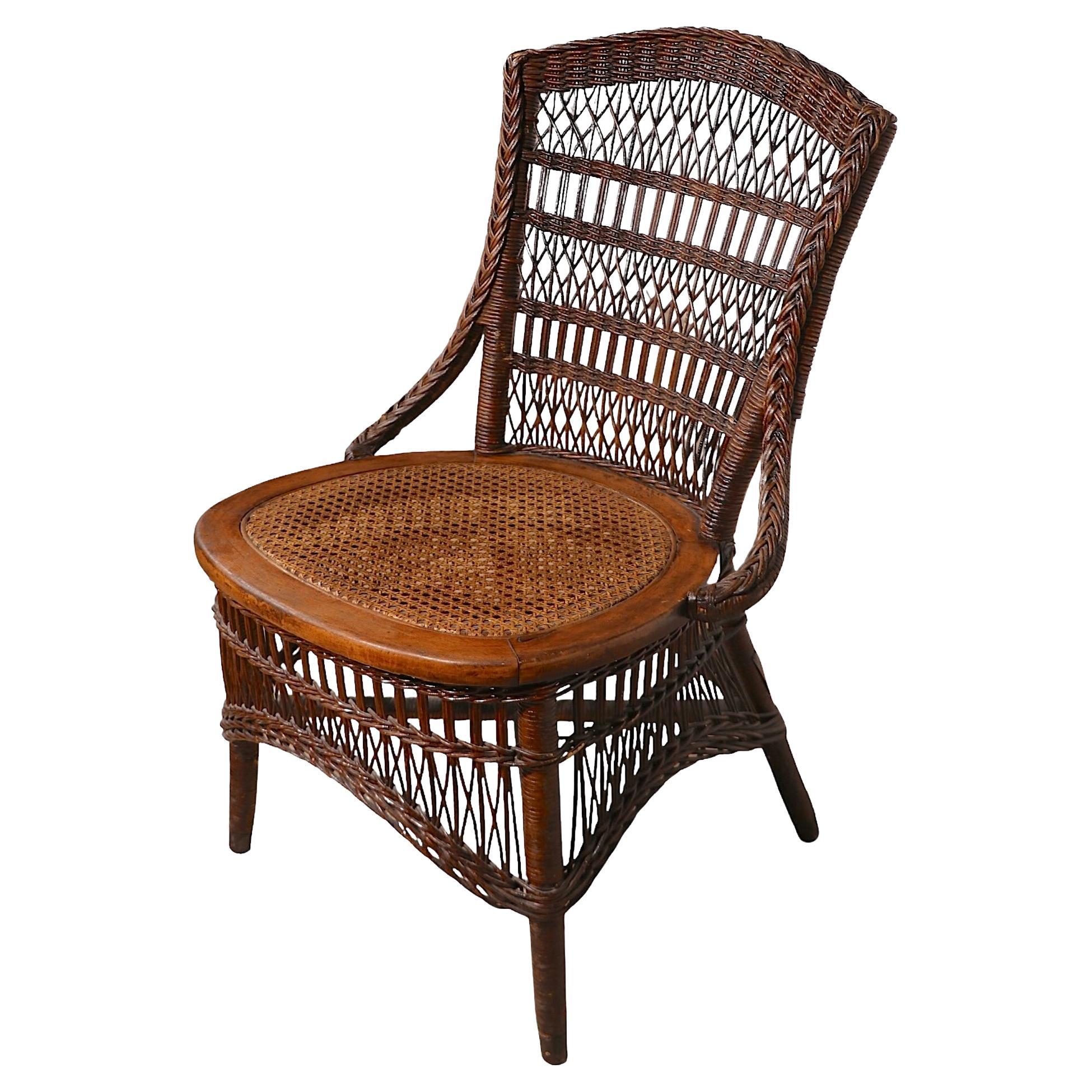 and rattan furnishings, produced in the popular styles of the day, including Aesthetic, Arts and Crafts, and early Art Deco influences. Heywood-Wakefield furniture found its way into porches, parlors, and conservatories across the country, alongside baby carriages, school furniture, and even seating for courthouses and theaters, a testament to just how broad the company’s manufacturing reach had become.
A turning point arrived from an unexpected direction in 1925, when a major international exhibition in Paris invited nations from across the West to showcase their most innovative furniture design. American manufacturers, still largely producing reproductions of eighteenth and nineteenth century styles, had little original work to contribute, and the resulting embarrassment pushed companies like Heywood-Wakefield to rethink their approach entirely. Over the following decade, the company began developing a genuinely modern design language of its own, one built around clean lines and light colored wood rather than the heavier, more ornamental furniture of previous generations.
That shift crystallized in 1935 and 1936 with the introduction of the Streamline Modern line, developed under designer Count Alexis de Sakhnoffsky and marking a dramatic break from the dark stained hardwoods that had defined American furniture for generations. Streamline Modern borrowed its sensibility from the aerodynamic design language sweeping through trains, automobiles, and architecture during the period, translating those same smooth, rounded forms into dining tables, bedroom sets, and case furniture. Achieving those graceful curves required a demanding technique called steam bending, in which dry lumber was saturated with live steam inside specialized machines until it became pliable enough to bend into shape without cracking, then dried for up to a full day to hold its new form permanently.
Heywood-Wakefield’s momentum continued building through the years following the Second World War, as postwar optimism and a booming housing market created enormous demand for exactly the kind of clean, modern furniture the company had spent the previous decade perfecting. New lines followed through the late 1940s, 1950s, and into the 1960s, including Encore, Kohinoor, and Contessa, each offering its own take on the company’s signature blend of solid birch or maple construction, rounded edges, and warm, light finishes known by names like Wheat and Champagne. Young families across the country furnished entire homes in Heywood-Wakefield, drawn to furniture that felt genuinely modern without sacrificing the quality of solid hardwood construction. The company also collaborated with talented designers of the era, including Gilbert Rohde and Russel Wright, whose influence helped keep the Heywood-Wakefield look feeling fresh and cohesive across its many product lines.
The company’s now iconic dark, wood burned eagle trademark did not actually appear until 1949, meaning many of the earliest and most coveted Streamline Modern pieces from the 1930s carry only fragile paper labels, if any identifying mark survives at all. For today’s collectors, that eagle stamp, often found on the underside of a tabletop or inside a drawer, remains one of the most reliable ways to authenticate a genuine piece.
By the mid-1960s, changing tastes and the rising cost of the company’s labor intensive, solid wood construction methods began working against Heywood-Wakefield, and production of its beloved Modern furniture line came to an end in 1966. 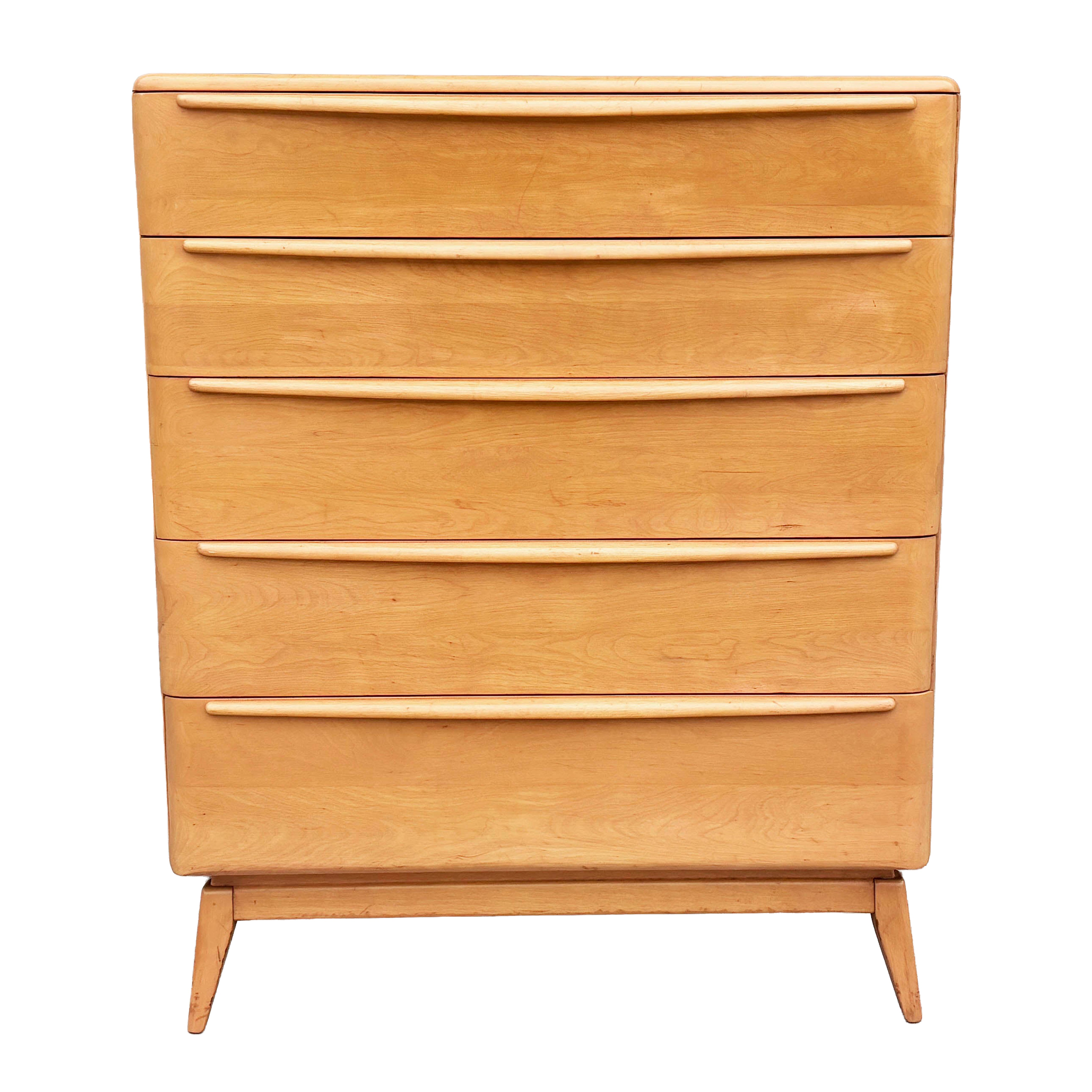 The broader company continued operating for over another decade, but shifting consumer preferences and mounting competition from overseas manufacturers eventually caught up with it entirely. The original Gardner, Massachusetts plant closed in 1979, and the company’s remaining operations ceased for good by 1981, bringing a genuine end to a business that had operated continuously for more than a century and a half.
Heywood-Wakefield’s story did not end there, however. In 1992, Miami Beach preservationists Andrew Capitman and Margaret Doyle, who had encountered original Heywood-Wakefield furniture while restoring historic Art Deco hotels in South Beach, partnered with furniture refinisher Leonard Riforgiato to acquire the rights to the company name. Their goal was straightforward: bring the beloved Streamline Modern designs back into production using the same values of quality and craftsmanship that had defined the original company. Today, under the direction of third generation Massachusetts woodworker Tom Belletete, Heywood-Wakefield furniture is once again built by hand in Massachusetts, using sustainably harvested American hardwood and construction methods that stay remarkably faithful to the originals that made the brand famous decades ago.
For collectors, vintage Heywood-Wakefield remains one of the most accessible and rewarding corners of mid-century modern furniture, prized for its solid wood construction, its distinctive blonde finishes, and pieces like the wishbone dining table and the so called dog bone chair that have become genuine icons of the style. Few furniture companies can claim a legacy stretching from a barn full of hand carved chairs in 1826 to some of the most recognizable design of the twentieth century, and fewer still have found their way back into production nearly a century after their signature look first captured the American imagination.
For anyone drawn to that same warm, streamlined style today, there are meaningful ways to bring a piece of the Heywood-Wakefield story home. An original vintage Heywood-Wakefield Streamline Modern piece carries the genuine craftsmanship and patina collectors search for. For those who love the look with modern durability, a newly built Heywood-Wakefield piece continues the same tradition using updated materials and joinery, and a set of mid-century modern blonde wood furniture rounds out a room with the same warm, rounded style that made Heywood-Wakefield a household name for generations of American families.