Some styles fade quietly into the past. Art Deco did the opposite. Nearly a century after it first appeared, its bold geometry, gleaming metals, and confident sense of glamour still show up on everything from jewelry to skyscrapers, as recognizable today as it was in the years between two world wars. Few design movements have managed to feel so completely of their moment while still speaking so clearly to ours.
The roots of Art Deco reach back to France in the years just before the First World War, a period of genuine artistic experimentation across Europe. Designers were pulling inspiration from an unusually wide range of sources at once, including the bold geometric forms of the Vienna Secession, the fractured planes of Cubism, and the vivid colors and exoticism of Sergei Diaghilev’s Ballets Russes. Ancient and international influences played a role as well, with designers borrowing motifs from Egypt, China, Japan, Persia, and Mesoamerica, folding them into something that felt distinctly modern rather than simply borrowed.
The war interrupted this early momentum, as it did so much else in Europe, but the years afterward gave the style room to fully take shape. France had suffered heavily during the conflict, and the country’s decorative artists saw an opportunity to look forward rather than back, positioning Paris once again as the center of taste and design for the rest of the world. Plans for a major exhibition devoted entirely to the decorative arts had actually been discussed as early as 1911, but war delays pushed the event back again and again, first to 1915, then 1922, then 1924, before it finally opened in the spring of 1925.
That exhibition, the Exposition Internationale des Arts Décoratifs et Industriels Modernes, opened in Paris in April of 1925 and ran for six months, drawing more than sixteen million visitors from twenty different countries. Organizers set strict rules for participants, requiring that every design shown be genuinely new rather than a copy of a historical style. The requirement was so strict that the United States was effectively excluded from participating, since American manufacturers at the time relied heavily on historical reproduction furniture and decor. 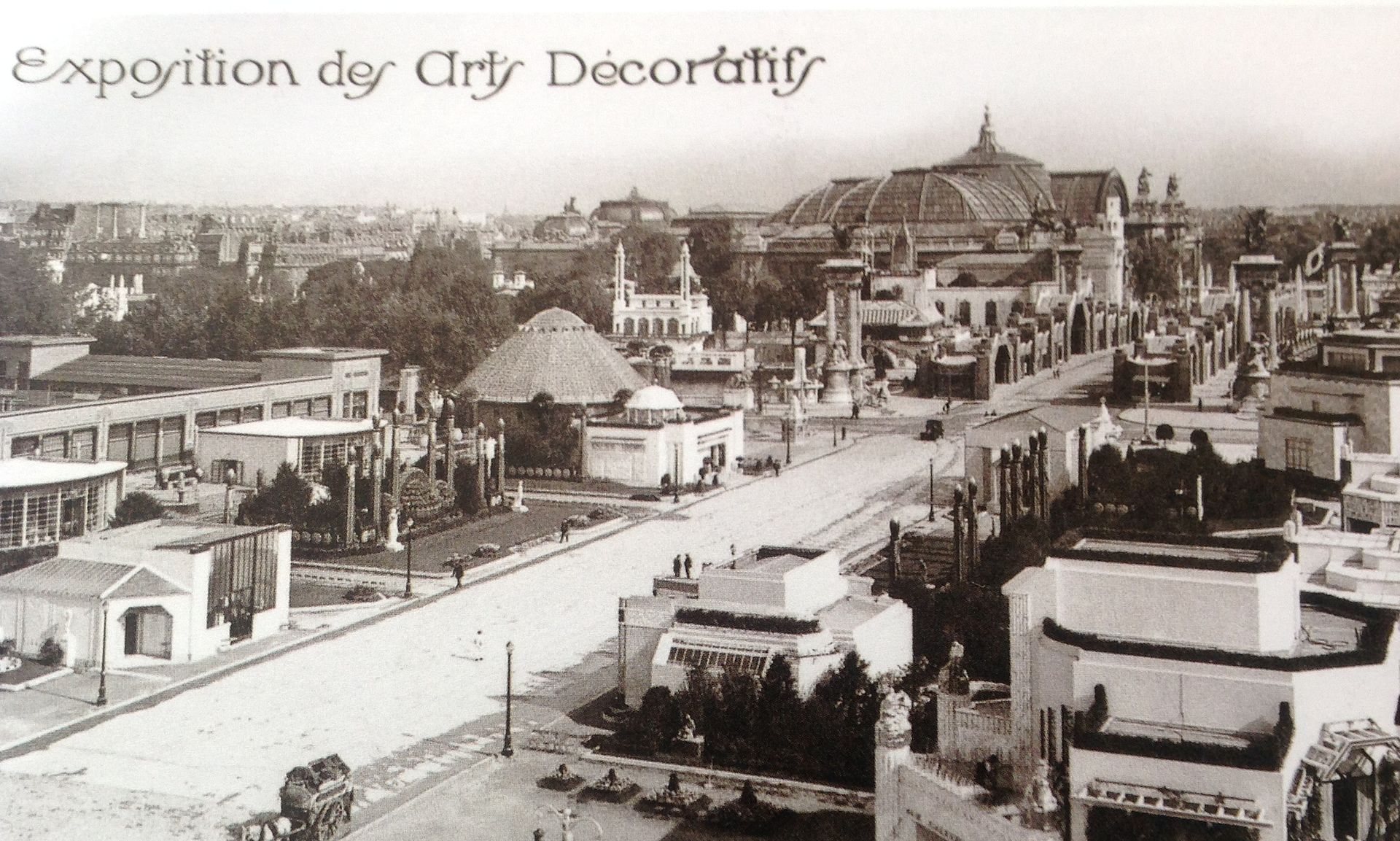 The exhibition sprawled across fifty five acres of central Paris, filling the Grand Palais and stretching along the banks of the Seine, and it became the moment when this new style, until then often called simply le style moderne, found an international audience.
What visitors encountered at the exhibition was a style built around clean lines, symmetry, and bold geometric ornament, well suited to the machine driven manufacturing methods of the era. Straight edges and repeating patterns were easier to produce at scale than the flowing, organic curves that had defined the earlier Art Nouveau movement, and Art Deco designers embraced that practicality without sacrificing luxury. Rich, often unusual materials appeared throughout the exhibition, including lacquer, ivory, and exotic woods alongside newer manufactured substances like chrome and Bakelite, combined in ways meant to feel unmistakably modern.
The style spread quickly beyond France in the years following the exhibition, and the United States, absent from the original event, became one of its most enthusiastic adopters during the following decade. American Art Deco found its fullest expression in architecture, rising most dramatically in the skyscrapers built across New York City during the late 1920s and early 1930s. Buildings such as the Chrysler Building and the Empire State Building translated the style’s geometric confidence into steel and stone, their stepped silhouettes and decorative crowns becoming instantly recognizable symbols of the era’s optimism, even as the country entered the hardship of the Great Depression.
Art Deco was never confined to buildings alone. The style touched nearly every corner of design during its peak years, shaping furniture, fashion, jewelry, and everyday household objects with the same geometric confidence found in its architecture. Jewelers embraced the look with particular enthusiasm, setting onyx against platinum and cutting gemstones into sharp, angular arrangements that stood in stark contrast to the softer, more naturalistic jewelry of earlier decades. Ocean liners, train interiors, and even household radios and vacuum cleaners took on the same streamlined, decorative sensibility, carrying Art Deco into daily life far beyond the reach of any single museum or exhibition hall.
Within the movement itself, two distinct camps had emerged by the time of the 1925 exhibition. Traditionalists favored fine craftsmanship and expensive natural materials, producing furniture and objects meant for a wealthy clientele. Modernists pushed in a different direction, favoring simplicity, mass production, and inexpensive materials suited to a wider audience. Both approaches shared the same underlying visual language, even as they disagreed about who the style was ultimately meant to serve.
By the late 1930s, the mood that had carried Art Deco through its peak years began to shift. The approach of the Second World War brought a more austere, streamlined sensibility to design, and the elaborate ornamentation that had defined the style’s early years gradually gave way to simpler, more functional forms. Though it never entirely disappeared, Art Deco’s original moment had largely passed by the time the war began.
Interest in the style resurfaced decades later, beginning in the late 1960s, when a wave of scholarly reappraisal and popular nostalgia rediscovered the era’s design. It was during this period that the term Art Deco itself came into common use, borrowed directly from the name of the 1925 exhibition that had first brought the style to the world’s attention decades earlier. That revival never really faded. Collectors and designers alike have continued returning to Art Deco in the decades since, drawn to its unmistakable confidence and its rare ability to feel both firmly of its time and strikingly current.
For anyone drawn to that same bold, geometric glamour today, there are still meaningful ways to bring a piece of the era home. An original vintage Art Deco jewelry brooch or decor piece carries the authentic craftsmanship collectors search for. For those who love the look without chasing a specific decade, Art Deco inspired home decor and art deco lighting captures the same geometric elegance for a modern space, and a set of vintage inspired barware or serving pieces rounds out the aesthetic with the same confident glamour that made Art Deco one of the most enduring design movements of the twentieth century.