Few objects manage to become part of the story of a home. They are not always rare antiques kept behind glass, waiting to be admired rather than used. More often they are the everyday pieces that quietly witnessed years of family meals, holidays, and ordinary moments that turned into something worth remembering. A favorite casserole dish, a well worn mixing bowl, a baking dish passed down through the years. For millions of American households, that object was Pyrex.
For more than a hundred years, Pyrex has held a familiar place in kitchens across the country. It showed up for birthday cakes, holiday casseroles, Sunday suppers, and the recipes handed down from one generation to the next. Many kitchen brands have faded as tastes changed, yet Pyrex remained, largely because it stood for something people genuinely valued: reliability, practicality, and a place in daily life that felt permanent.
The story begins in 1915 at Corning Glass Works in Corning, New York.  Corning already had a reputation for glass innovation, having produced the glass used in railroad lanterns. Researchers there found that a particular formulation, known as borosilicate glass, could withstand sudden temperature changes without cracking the way ordinary glass did. That discovery became the foundation for a product that would go on to reshape the American kitchen.
Pyrex arrived at a moment when households were looking for smarter, more efficient ways to manage daily cooking. Traditional cookware simply could not handle rapid changes in temperature, and families wanted something built for a faster and more organized way of life. Pyrex answered that need by letting cooks move a dish straight from the refrigerator to a hot oven and then directly to the table, without swapping containers or losing time.
The earliest Pyrex pieces were plain and purposeful, including pie plates, casserole dishes, and custard cups. One of the biggest advantages was the clear glass itself. Home cooks could watch their food bake instead of guessing through a closed oven door.
That kind of practicality mattered deeply to families in the early twentieth century, who bought household goods with the expectation that they would last for years rather than seasons. Pyrex was built with that expectation in mind, and it delivered. Over time, individual dishes became attached to specific memories, such as the pan that always held a grandmother’s apple pie or the casserole dish that appeared at every holiday gathering. Nobody thought of these pieces as special while they were in daily use. Looking back, that is exactly what made them special.
After World War II, American homes entered a new era of design and optimism. Appliances gained color, kitchens gained personality, and household items were no longer valued for function alone. They became a way for people to express their own style. Pyrex followed that shift by introducing colorful patterns and decorative mixing bowl sets that reflected the mood of the 1950s and 1960s. 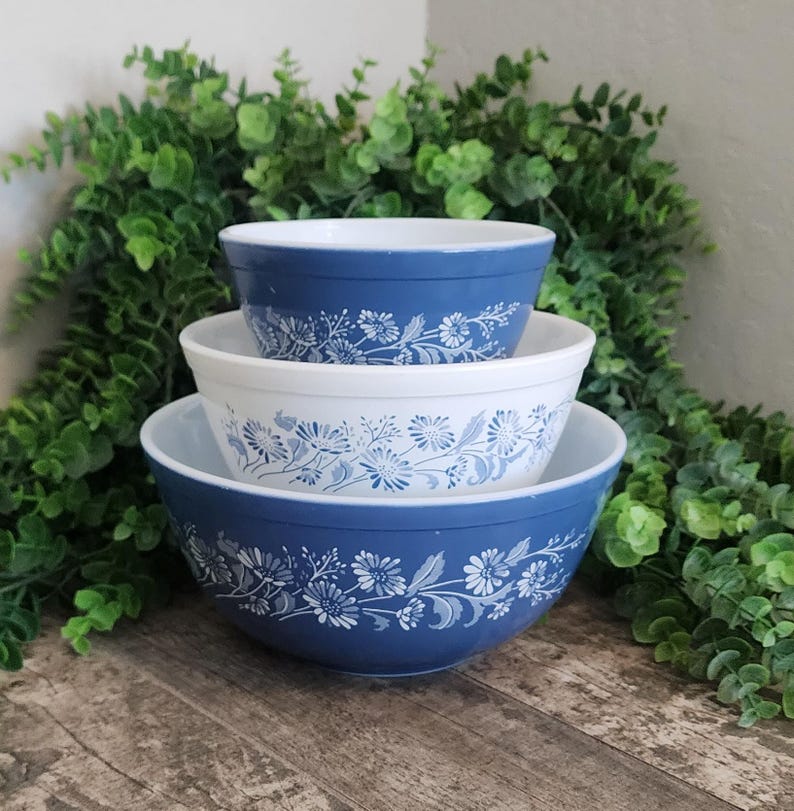 These bowls were attractive enough to sit out on the counter as part of the kitchen’s décor rather than staying tucked away in a cabinet.
Certain patterns from this era became lasting favorites among collectors. Butterprint, Gooseberry, and Snowflake Blue each bring to mind a particular version of the mid century kitchen. Collectors will spend years searching for a single missing bowl, working through estate sales, flea markets, and antique shops in hopes of finding it.
The appeal of vintage Pyrex goes beyond the object itself. For most collectors, it is really about the connection to the past, whether that means a pattern that recalls a childhood kitchen or the memory of watching a parent or grandparent cook. These dishes carry stories, and it is usually the story, not the glass, that people are collecting.
This reflects a wider appreciation for older household goods in general, a preference for things that were built to be kept rather than replaced. Pyrex fits naturally into that way of thinking, which helps explain why the brand continues to gain new admirers. Younger collectors are discovering these bowls today through antique markets, family collections, and social media, and what was once considered ordinary kitchenware has become something closer to a symbol of nostalgia and lasting design.
In the end, Pyrex represents more than a brand name printed on a bowl. It represents the memories built around food and family, kitchens filled with conversation, recipes written by hand, and meals prepared with care. Using a familiar dish has a way of connecting the present to the past that few household objects can match.
For anyone hoping to bring that same mid century warmth into their own kitchen today, a few pieces make it easy. An original vintage Pyrex Butterprint or Pyrex Gooseberry mixing bowl set is the real thing for collectors who want authentic history on the shelf. For those who would rather enjoy the look without the search, a retro inspired glass mixing bowl set offers the same colorful, oven to table charm for everyday use, and a set of glass food storage containers rounds out the collection with the same practical spirit that made Pyrex a household name in the first place.