There is a particular kind of jewelry that was never meant to catch the light or draw admiration. It was meant to hold on. Mourning jewelry, worn to remember someone who had died, represents one of history’s most personal forms of adornment, a tradition that turned grief itself into something that could be carried, touched, and kept close for the rest of a lifetime.
The impulse behind mourning jewelry reaches back much further than the era most associated with it today. Ancient Egyptians fashioned protective amulets from stones like lapis lazuli and carnelian, shaped into scarabs and other symbols meant to accompany the dead on their journey to the afterlife while also comforting those left behind. Memorial rings appeared in England as early as the seventeenth century, including pieces that circulated among the supporters of King Charles I after his execution in 1649, worn as a quiet act of loyalty and remembrance. Long before Victoria ever wore black, the basic idea of wearing jewelry to honor the dead already had deep roots across cultures and centuries.
What changed in the nineteenth century was scale. Life in this period carried death as a near constant companion. Diseases like cholera, typhus, and tuberculosis moved through communities with little warning, childhood mortality was tragically high, and in America the Civil War alone claimed roughly seven hundred and fifty thousand lives. Nearly everyone had personal, direct experience with loss, and Victorian society responded by building an entire structured culture around mourning, complete with expected clothing, timelines, and rituals that guided a grieving family through their loss in full view of their community.
No single figure shaped that culture more than Queen Victoria herself. When her husband, Prince Albert, died in 1861, Victoria began a period of mourning that would last for the remaining four decades of her life. She wore black for the rest of her days, kept a cast of Albert’s hand near her, and slept with reminders of him close at hand. As the ruling monarch of an empire, her prolonged and deeply personal grief became something the public could witness and, in many ways, imitate. Mourning jewelry, once primarily the province of the wealthy, spread rapidly through the middle class as Victoria’s example turned visible grief into both a social expectation and a genuine fashion.
Strict etiquette governed exactly how mourning was meant to look and for how long. A widow typically observed full mourning for a year and a day, dressed entirely in matte black without lace, shine, or ornamentation of any kind. 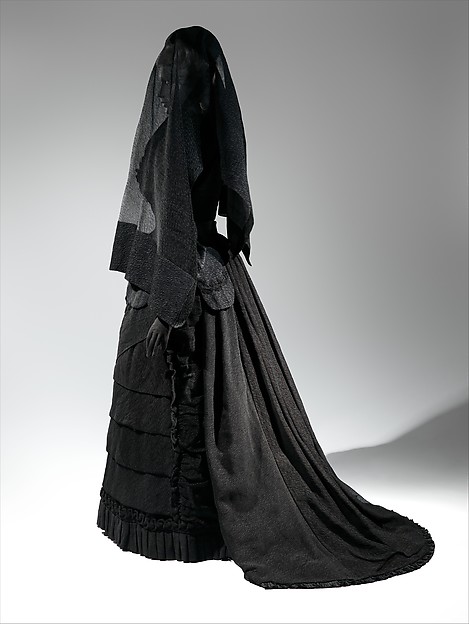 From there, she moved gradually into half mourning, when small amounts of grey, mauve, or white could reenter her wardrobe, along with a narrower range of acceptable jewelry made only from black materials like jet, gutta percha, or vulcanite. The length and intensity of mourning was carefully calibrated to the closeness of the relationship, with even children expected to wear black armbands and small jet brooches for a lost parent or sibling.
Jet became the defining material of high Victorian mourning almost by accident of geography. This lightweight, fossilized material, found in its finest form near the seaside town of Whitby in Yorkshire, could be carved into intricate designs and polished to a deep, warm shine, making it ideally suited to the elaborate brooches, crosses, and beads mourning fashion demanded. Queen Victoria’s own patronage sent demand soaring, and the Whitby jet industry grew rapidly through the 1870s, at one point employing hundreds of skilled craftsmen. As the fashion spread beyond those who could afford genuine Whitby jet, cheaper alternatives followed close behind, including French jet, which was actually a black glass imitation, along with vulcanite and bog oak harvested from Irish peat bogs, each offering a similar look at a more accessible price.
Nearly every element of a piece of mourning jewelry carried specific, readable meaning to Victorian eyes. A weeping willow signified sorrow, an urn represented the earthly body left behind, and an anchor stood for hope and steadfast faith. Small pearls scattered through a design were understood to represent tears. White enamel, rather than black, indicated that the person being mourned was a child or an unmarried woman, a nod to purity rather than the deep grief signaled by black. A piece of mourning jewelry was never simply decorative. It was a small, wearable message, legible to anyone versed in its particular grammar of loss.
Hair held an especially significant place in mourning tradition, treasured because, unlike almost anything else connected to a person, it does not decay. Families wove locks of a loved one’s hair into rings, brooches, and lockets, sometimes displayed simply beneath a small pane of glass and other times worked into remarkably detailed scenes, including gravestones, willow trees, or elaborate wreaths built from the hair of an entire family across generations. Crafting hairwork became a genuine skill taught to young Victorian women, often alongside needlework, and while wealthier families could commission elaborate pieces from professional workshops, instructional manuals of the period also allowed ordinary women to create their own hair jewelry at home. It is worth noting that hair jewelry was not always about mourning specifically. Locks of hair were also exchanged between living friends and lovers as tokens of affection, and telling a mourning piece from a sentimental keepsake often depends on small clues like black enamel, an engraved date, or a symbol of grief rather than romance.
By the final decades of the nineteenth century, the elaborate culture surrounding mourning jewelry began to fade. Queen Victoria herself gradually relaxed the strictness of her own mourning in later years, and broader shifts in fashion moved away from the heavy, layered aesthetic that mourning jewelry had once complemented so naturally. Changing ideas about hygiene also played a role, as dust laden Victorian interiors and their many textured, hard to clean objects fell out of favor. With Victoria’s death in 1901, the era’s most visible mourner was gone, and the tradition she had done so much to popularize slowly receded from everyday fashion.
What remains today is a genuinely fascinating category of antique jewelry, valued as much for its emotional weight as for its craftsmanship. A well preserved piece of Victorian mourning jewelry, whether carved from Whitby jet or woven from a stranger’s carefully preserved hair, offers a direct, tactile connection to a culture that once treated grief not as something to hide, but as something to wear.
For anyone drawn to that same history today, there are meaningful ways to bring a piece of it into a collection. An original antique Victorian mourning brooch or ring carries the genuine craftsmanship and symbolism collectors search for. For those interested in the hairwork tradition specifically, a Victorian hair jewelry piece offers a rare glimpse into one of the era’s most intimate art forms, and a set of black onyx or jet inspired jewelry captures the same somber elegance for those drawn to the aesthetic without seeking an antique piece specifically.