There was a time when nearly every town in America, no matter how small, had one store where a person could walk in with a little pocket change and walk out with something worth having. The five and dime store was not a place people visited for one specific need. It was a destination in itself, a place to browse candy, ribbon, hardware, toys, and household goods all under one roof, all priced so plainly that a child could count out the cost in coins. For generations of Americans, the five and dime was simply part of daily life.
The idea traces back to a young man named Frank Winfield Woolworth, who grew up in a modest farming family in New York and had little formal education. He took a job as a clerk in a dry goods store in Watertown, New York, where he proved to be, in his own words, a poor salesman. What he lacked in charm at the counter, he made up for with an eye for display, arranging goods so they practically sold themselves without a clerk standing over the customer’s shoulder.
That instinct led him to a bigger idea. At the time, most stores kept merchandise behind the counter, unpriced, requiring a customer to ask a clerk for help and often haggle over cost. Woolworth believed shopping could be simpler. He set out to sell goods with a price already fixed and displayed openly on tables, where a customer could pick up an item, decide for themselves, and pay without ever needing to negotiate.
In February of 1879, Woolworth borrowed three hundred dollars and opened his first store in Utica, New York, selling everything for five cents. That first store failed within weeks, closing almost as quickly as it opened. Rather than give up, Woolworth tried again just months later in Lancaster, Pennsylvania, this time adding items priced at ten cents alongside the nickel goods. That second store succeeded, and the five and dime concept was born. 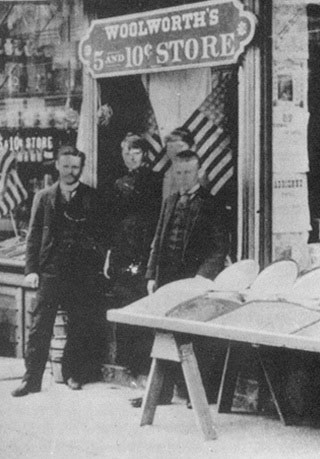
Word of the idea spread quickly, in part because it was so easy to understand. A store where absolutely everything cost five or ten cents removed all the guesswork and all the intimidation that could come with shopping elsewhere. Working families who might have felt out of place in a larger, more expensive store found the five and dime approachable and honest. Within a decade, Woolworth had a dozen thriving locations, and by the turn of the century his stores numbered in the dozens more, spreading across the Northeast and beyond.
Woolworth’s success did not go unnoticed. Family members and former employees opened five and dime stores of their own, some in direct competition and others in eventual partnership. In 1911, Woolworth combined forces with several of these rival chains, including ones run by his own cousin and brother, to form a single national company under his name. The result was one of the first true nationwide retail chains in American history, with hundreds of stores from coast to coast.
By the time Frank Woolworth died in 1919, his stores numbered over a thousand across the United States and Canada. The five and dime had become a genuine institution, and Woolworth’s name in particular was so closely tied to the concept that for many Americans the words five and dime and Woolworth’s meant essentially the same thing. Other chains carried the idea forward as well, each with its own regional following, but Woolworth’s remained the store most people pictured when they thought of a dime store downtown.
The five and dime occupied a unique place on Main Street. It was rarely the fanciest store in town, but it was often the busiest. Children pressed their faces against the toy counters. Families picked out fabric, sewing notions, and kitchen goods. Many locations added lunch counters, where a sandwich or a soda could be had for pocket change, and those counters became meeting places in their own right, part soda fountain and part town gathering spot.
The five and dime also held an important, more difficult place in American history. In 1960, four Black college students sat down at a segregated Woolworth’s lunch counter in Greensboro, North Carolina, and refused to leave without being served. Their peaceful protest sparked similar sit ins across the South and became one of the defining moments of the civil rights movement, a reminder that even the most ordinary corners of daily life were part of a much larger struggle for equality.
Through the Great Depression, two world wars, and the growth of suburban America, the five and dime adapted without losing its basic character. Prices crept upward over the decades, eventually well beyond a nickel or a dime, but the spirit of the store, affordable goods, open displays, and a little of everything under one roof, stayed remarkably consistent.
By the second half of the twentieth century, larger discount department stores began to take the five and dime concept and expand it dramatically, offering the same broad selection and fixed pricing but on a much bigger scale. Many of these new chains, in fact, were founded by five and dime companies looking to grow with the times. The classic dime store slowly gave way to something larger, and by the 1990s most of the original Woolworth locations across the country had closed for good.
Even so, the five and dime never entirely disappeared from American memory. A handful of independent dime stores still operate today, often run by the descendants of their original owners, preserving creaking wood floors, penny candy counters, and the same sense of unpretentious variety that made the concept beloved in the first place. For those who remember shopping at one, the five and dime represents a simpler kind of retail, where nothing was too fancy and almost everything was within reach.
For anyone who still feels the pull of that nostalgia, there are a few ways to bring a bit of the five and dime spirit home. A piece of vintage Woolworth’s or dime store advertising makes a fitting reminder of the era for a collector’s wall. For those drawn to the goods themselves, a set of vintage tin toys or notions captures the charm of a dime store counter, and a reproduction penny candy or general store sign rounds out the look with the same simple, welcoming character that made five and dime stores a fixture of small town America for the better part of a century.